Puebla's grey-stone cathedral and the shaded square in front of it are the natural place to start: the old grid of streets, the arcades and the towers all lead back here.
- Best months: October to May, dry season
- Getting there: Walk; the square is the centre's hub
- Bring: Sun hat, light layer, covered shoulders for the cathedral
- Altitude: About 2,100 m: strong midday sun, cool mornings and evenings, afternoon storms in the rainy months.
Puebla was laid out by the Spanish in the early 1530s as Puebla de los Ángeles, a new city on open ground between the volcanoes and the old towns of the valley. Its planners gave it a regular grid of streets, and at the centre of that grid they placed a large square with the cathedral on one side. Nearly five centuries later the arrangement still works. You can stand in the middle of the zócalo and see how the whole historic centre hangs off it, block by block, and most of what this site covers lies within a short walk.
A square built for the city's daily life
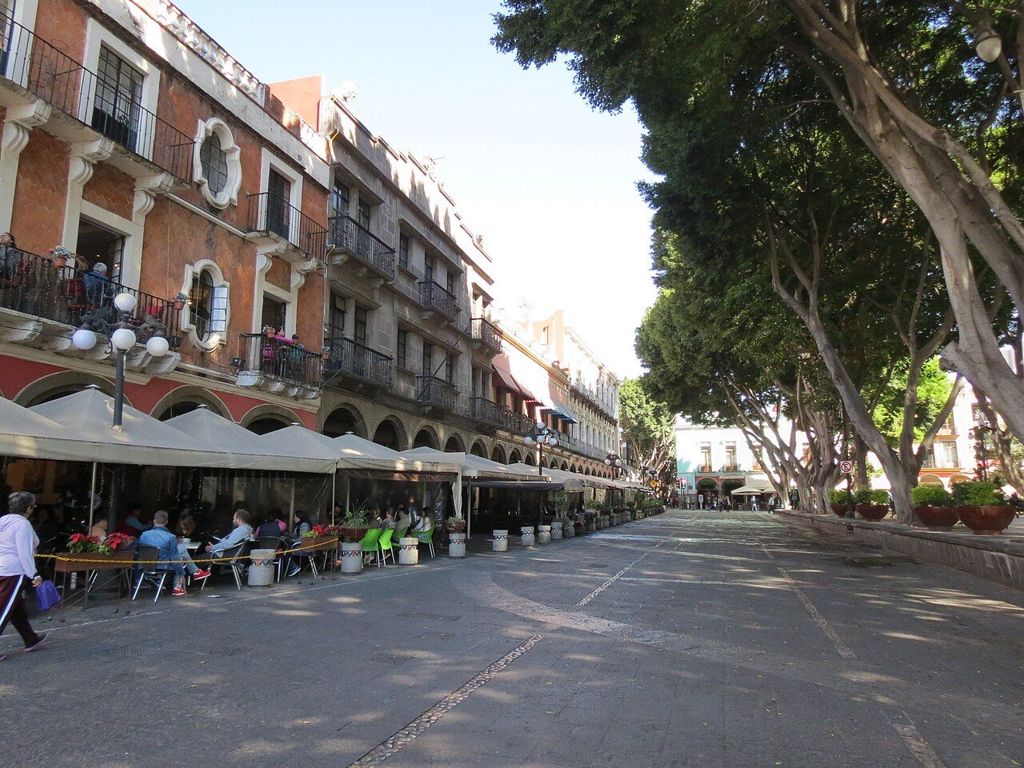
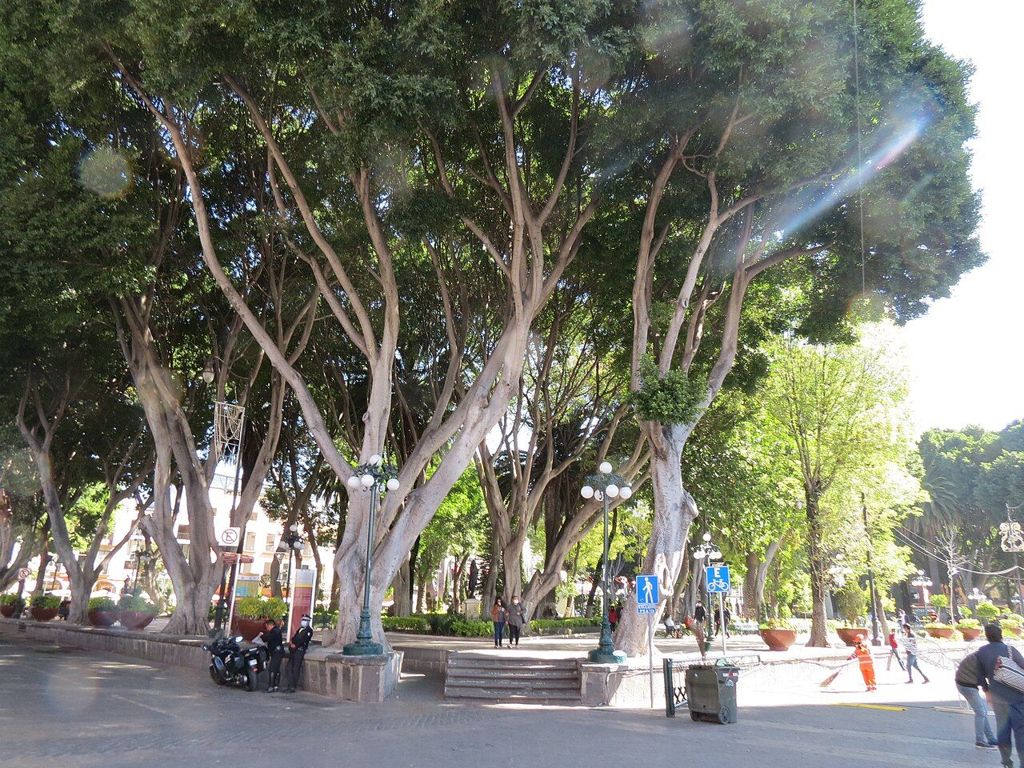
The zócalo is a broad, tree-shaded plaza, its paths crossing between flower beds and benches under old trees with pale, twisting trunks. On three sides it is framed by arcades, the portales, whose stone arches carry two or three storeys of balconied buildings above. On the fourth side, the south, stands the cathedral.
The arcades are the square's living rooms. Their deep shade keeps the pavements cool at midday, and tables spill out under the arches from morning until late. In the plaza itself you find shoe-shine stands, balloon sellers, families on benches and office workers crossing on their way somewhere else. The government building on the north side faces the cathedral across the trees, the old pairing of civic and church power that you see in many Mexican colonial towns.
The square is at its best early in the morning, when the light is low and the sweepers are still at work, and again in the late afternoon, when the stone warms to gold and the benches fill. Sundays bring the most people and the most life.
The cathedral from outside
Puebla Cathedral took most of a century to build. Work on the present building went on through the late sixteenth and early seventeenth centuries, and it was consecrated in 1649 under Bishop Juan de Palafox y Mendoza, the same bishop whose books founded the library next door. The result is a sober, massive church of grey stone, quite different from the tiled and gilded buildings elsewhere in the city.
Its two bell towers are among the tallest of any church in Mexico, and they are the first thing you see of Puebla from many points across the centre. Look at the main façade and you see a severe Renaissance design: columns, niches and carved reliefs arranged in strict, flat tiers, with little of the swirling Baroque ornament that came later. The darker stone gives the building a weight that the brick-and-tile houses around it lack.
A local story holds that one of the great bells was too heavy to raise and was lifted into the tower overnight by angels. It is told as a legend, and it fits a city whose very name honours angels.
Inside: altars, chapels and quiet
The interior is long and high, with side chapels running down both aisles. At the crossing stands the main altar, a great free-standing structure of stone, marble and gilding designed at the turn of the nineteenth century in a cooler neoclassical style. The choir stalls, the side altars and the paintings in the chapels reward a slow walk; take the aisles one at a time rather than trying to see everything from the nave.
This is a working cathedral. Masses run through the day, and visitors are expected to keep to the edges during services, speak quietly and dress modestly, with shoulders covered and hats off. Opening hours and any times when visitors are restricted change with the church calendar, so check before you go and plan around Sunday mornings if you want a quieter look. Photography rules also vary; follow any signs at the door.
Also in Puebla: Atlixco and the view of Popocatépetl
Once you have seen the interior, step out by the side door and walk around the outside of the building. The walls and the railings on the north side, facing the square, give the clearest sense of its size.
The historic centre and its listing
UNESCO added the Historic Centre of Puebla to the World Heritage List in 1987. The listing covers a large area of the old grid: churches, convents, colleges, mansions and some thousands of historic buildings. What stands out is how much survives and how varied it is. Within a few blocks of the zócalo you pass grey-stone churches, red-brick houses faced with glazed tiles and white stucco worked into fine ornament.
The tiles deserve their own walk; the guide to reading the city's Talavera façades picks out the best streets. Directly beside the cathedral, on its south side, the old college building holds the Biblioteca Palafoxiana, and a few blocks north the Templo de Santo Domingo hides one of the most richly gilded chapels in Mexico.
Timing your visit
Puebla sits at about 2,100 metres, and the altitude shapes the day. Mornings can be cool, the sun at midday is strong, and in the rainy season, roughly June to September, afternoon storms often roll in. A good pattern is to visit churches and museums in the morning, rest in the arcade shade through the middle of the day, and come back to the square as the light softens.
Major religious festivals, Holy Week above all, bring processions and crowds to the cathedral and the streets around it. They are worth seeing if your dates line up, but expect closures and restricted access to parts of the building.
Practical notes
- The centre is compact and flat, and walking is the easiest way around it. Streets follow a numbered grid, which makes it hard to get lost for long.
- Entry to the cathedral has generally been free, but some areas or towers may have separate arrangements; check before you go.
- Pickpocketing happens in any busy square. Keep bags closed and phones out of back pockets.
- Puebla's food is part of the visit. Mole poblano, a dark sauce of chiles, spices, seeds and chocolate, and chiles en nogada, stuffed chiles under a walnut sauce served mainly in late summer, are the city's two famous dishes.
From the zócalo the wider region is easy to reach. Cholula lies a short ride to the west, where the buried pyramid under a church-topped hill makes a good half-day trip, and on clear mornings you can see the snow of the volcanoes from the higher streets of the city.