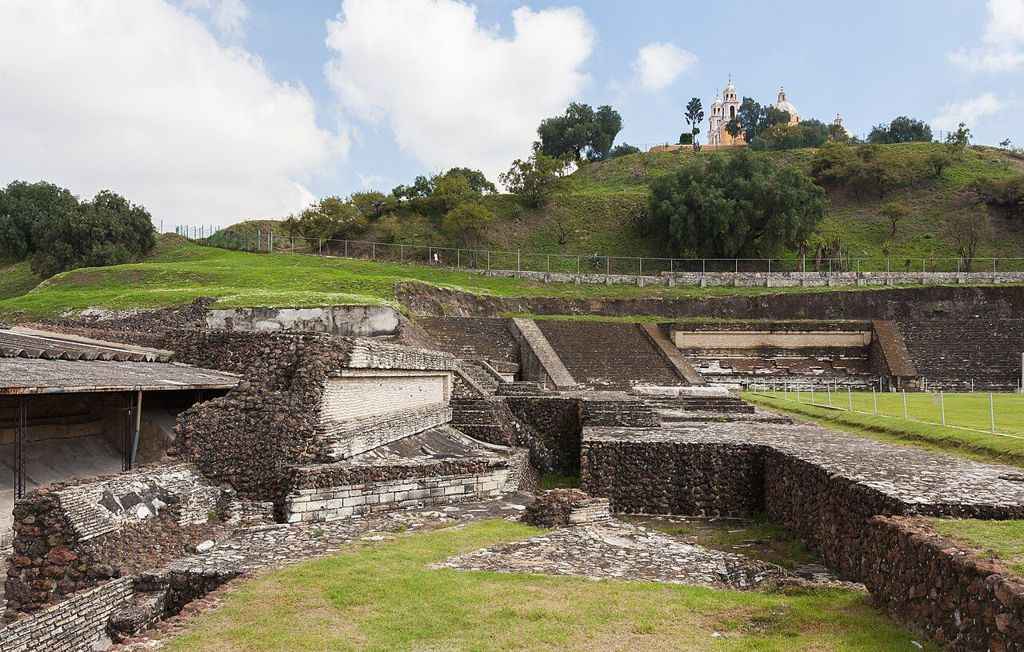
West of Puebla, a grassy hill topped by a yellow church turns out to be the largest pyramid by volume in the world. Most of it is still underground.
- Best months: October to April, clear mornings
- Getting there: Short bus or taxi ride west of Puebla
- Bring: Water, sun hat, sturdy shoes, a light jacket
- Altitude: About 2,150 m: thin dry air, hot sun on the climb, storms on summer afternoons.
From the streets of Cholula it looks like a natural hill, steep and green, with a church sitting on top. It is not. Under the grass lies the Great Pyramid of Cholula, known in Nahuatl as Tlachihualtepetl, the made mountain. By volume it is the largest pyramid in the world, broader at its base than the Great Pyramid of Giza, though much lower. Centuries of building, abandonment and overgrowth turned it into a hill, and the Spanish built a church on its summit. Today you can visit the excavated ruins at its foot, a stretch of tunnel through its core and the church above.
Cholula, an old holy city
Cholula is one of the oldest continuously inhabited places in Mexico. It was a major religious centre for many centuries before the Spanish arrived, and the pyramid was its great temple, enlarged in several building phases over a long period. When the Spanish came in 1519, the city was still large and important, and the conquest brought a massacre there that is remembered as one of the darkest episodes of the campaign.
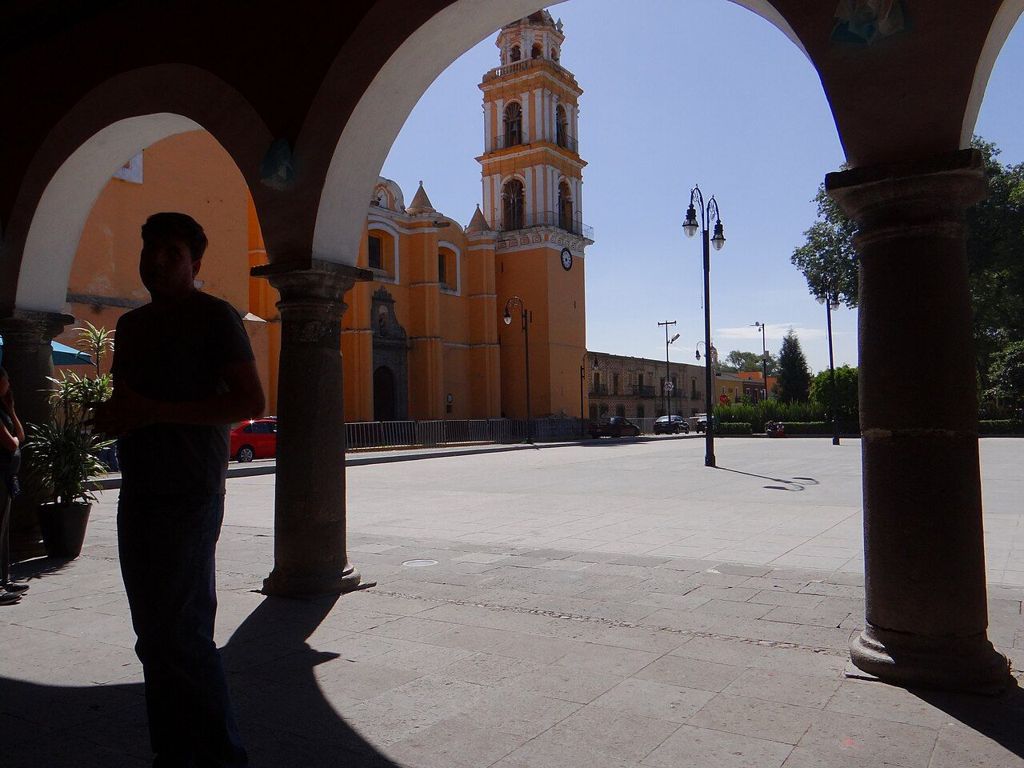
Today Cholula is split into two municipalities, San Pedro Cholula and San Andrés Cholula, with the pyramid between them. It is close enough to Puebla to feel like an extension of the city, yet it keeps its own character, with a large main square, many churches and a university population.
The excavated side
Excavation began in earnest in the 1930s. Archaeologists tunnelled into the pyramid to study its layers rather than strip away the hill and the church, and later work exposed parts of the base on the south and west sides. The open area at the foot shows stepped platforms, stairways and plazas, including a courtyard known as the Patio of the Altars, with stone slabs and carved panels.
Walking through this area gives a sense of the scale. The terraces you see are only the edge of something far larger, and the grassed slope rising behind them is the pyramid's body. A small site museum nearby helps explain the building phases and the murals found inside.
The tunnels
The archaeological tunnels run for several kilometres in total, but only a short section has usually been open to visitors. It is a narrow, dim passage through packed earth and stone, low in places, with glimpses of older walls and stairs where the tunnel cuts through them. The route has closed at times for safety work, and rules about access change, so check before you go. If you dislike confined spaces, you can skip the tunnel and still see the excavated plazas outside.
Also in Puebla: The Palafoxiana, the Americas' first public library
The church on top
The Santuario de Nuestra Señora de los Remedios crowns the hill. The Spanish built a church there in the sixteenth century, and the present building has been repaired and partly rebuilt after earthquakes, most recently after 2017. Its yellow walls and tiled domes are visible from far across the valley.
Inside, the church is bright and richly decorated, with gilded altars and a revered image of the Virgin of the Remedies above the main altar. Outside, the terrace around it looks down over Cholula's grid of streets and the many church domes and towers that rise above the roofs. A popular saying credits the town with a church for every day of the year. The true count is lower, but standing on the summit you can see why the saying took hold.
A path with steps climbs from the town to the church. It is steep and exposed, and at this altitude it can leave you short of breath, so take it slowly and carry water. The church is a place of pilgrimage and worship, especially around its feast in early September, so dress modestly and keep your voice down inside.
Popocatépetl on clear days
The summit gives the best view in the area. To the west and south-west, on a clear morning, the snow-capped cone of Popocatépetl rises above the plain, with Iztaccíhuatl's long ridge beside it. The view is clearest in the dry months, early in the day, before haze and cloud build up. In the rainy season the volcanoes are often hidden by afternoon.
Popocatépetl is an active volcano, and from time to time it sends up plumes of gas and ash. The guide to Atlixco and the volcano explains the alert system in general terms. From Cholula you are at a safe distance, but ash can occasionally fall across the region and affect flights.
Getting there and getting around
- Cholula lies a short way west of central Puebla. Local buses and taxis connect the two; journey times depend on traffic. Arrangements are revised often, so confirm them first.
- The archaeological zone usually charges an entry fee and keeps set hours, often closing on one day a week. Confirm the current details before you travel.
- Climbing to the church is generally free, but access can be restricted during works or festivals.
- Allow half a day: an hour or two for the site and tunnel, the climb, and time for the main square.
Cholula's own square has one of the longest arcades in the country and a cluster of colonial churches, including tiled domes worth comparing with the Talavera façades of Puebla. Pair the trip with a morning in the historic centre of Puebla and you see both sides of the region's history in one day: the older holy city under the hill, and the colonial city laid out beside it.