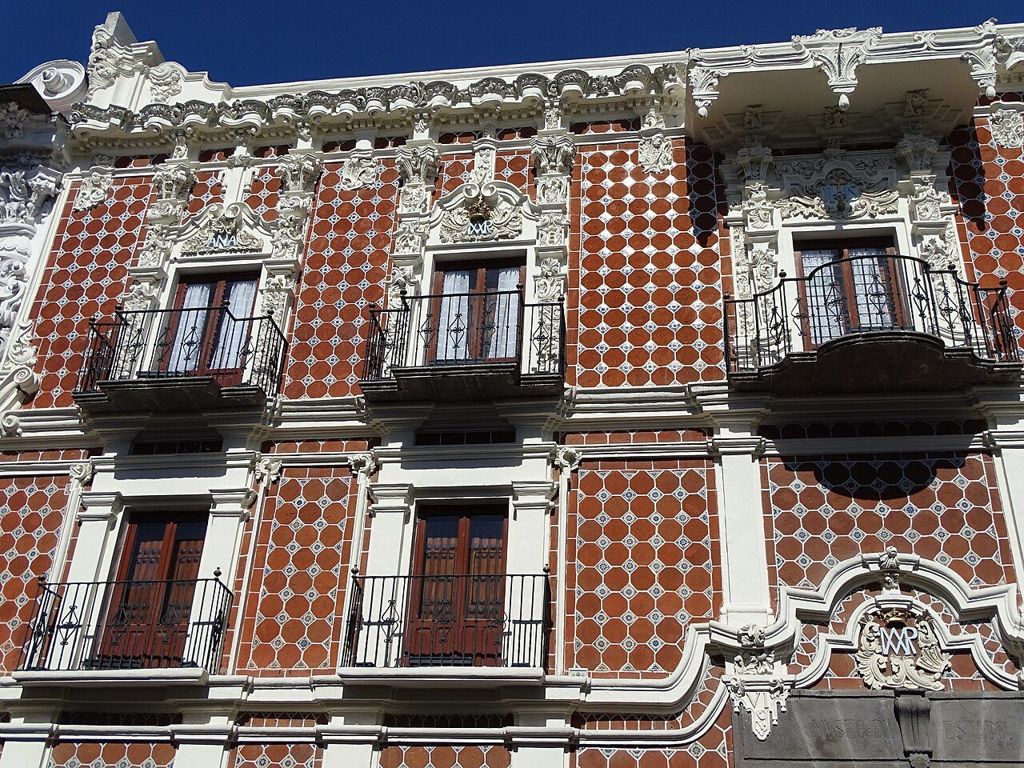
Glazed tiles cover house fronts, church domes and kitchen walls across Puebla. Once you know what to look for, a walk through the old centre turns into a lesson in craft and history.
- Best months: Dry season, October to May
- Getting there: On foot around the historic centre
- Bring: Comfortable shoes, camera, a little patience for detail
- Altitude: About 2,100 m: bright sun on the façades, cool shade, rain most summer afternoons.
Walk a few blocks from the main square in Puebla and you start to notice the walls. House fronts are faced with red brick set in diamond and hexagon patterns, broken by small glazed tiles in blue, white and yellow. Church domes shine with tiles laid in zigzags and chequers. Doorways, fountains and kitchens carry painted panels. This is Talavera, the tin-glazed pottery that has been made in and around Puebla since the colonial period, and the city wears it on the outside.
Where the craft came from
The technique arrived from Spain in the sixteenth century. Potters from the region of Talavera de la Reina, in central Spain, brought their methods of glazing and painting earthenware, which themselves drew on older Islamic and Italian traditions. In Puebla they found good clay and a growing city that needed tiles, jars and tableware for its churches, convents and houses. Over time a local style took shape, mixing Spanish, Moorish, Chinese and indigenous influences in its patterns.
The potters organised themselves into a guild with rules on materials, colours and quality, and those rules shaped the look of the ware that survives. Talavera poblana is still made by a small number of workshops in the city and nearby towns, and the traditional method is slow and done largely by hand.
How Talavera is made
In general terms, the process runs like this:
- Two local clays are mixed, soaked and worked until smooth, then left to rest.
- Pieces are shaped on the wheel or pressed into moulds, and tiles are cut from flat slabs.
- After slow drying, the pieces get a first firing.
- They are dipped in a thick white glaze based on tin, which gives Talavera its milky ground.
- Painters apply the designs by hand with mineral colours, then the piece is fired again, fusing the colours into the glaze.
The traditional palette is limited to a handful of colours, with cobalt blue the most famous. The paint sits slightly raised on the surface of good pieces, which you can sometimes feel with a fingertip. A full cycle from raw clay to finished piece takes weeks or months.
The Casa de los Muñecos
The best single façade to start with stands just off the zócalo. The Casa de los Muñecos, the House of the Dolls, is an eighteenth-century mansion whose front is covered in brick and tile, with large tile panels showing human figures in odd, theatrical poses. A long-told story says the owner commissioned them to mock the city councillors who had objected to his building being taller than theirs. It is a legend rather than a documented fact, but it suits the figures, which look like a row of caricatures.
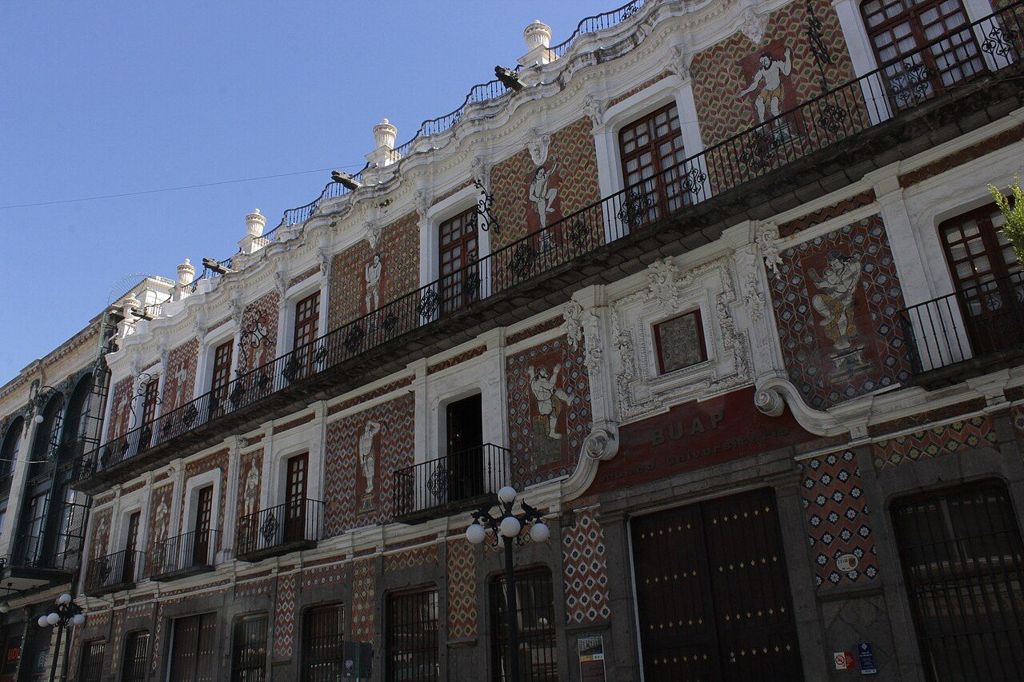
The building now belongs to the state university and houses a museum. Stand across the street to see the full front; the figures are easiest to read in the morning, before the sun moves round. The house sits a minute from the cathedral and the zócalo, so it fits easily into a first walk.
Also in Puebla: Cholula's buried pyramid
How to read a tiled façade
Once you start looking, Puebla's house fronts fall into a few patterns:
- Brick and tile together. The most common style sets red brick in geometric patterns, with small glazed tiles at the joints. From a distance the wall reads as a single textured surface; up close it is a careful grid.
- Full tile panels. Some fronts, like the Casa de los Muñecos, carry large painted scenes or figures built up from many tiles.
- White stucco ornament. Many tiled houses frame their windows and cornices in white plaster worked into curls and scrolls, so thick and fine that Puebla gave the style its own name after a sugar paste sweet, alfeñique.
- Church domes. Look up. Tiled domes in yellow, green and blue rise above the rooftops across the centre and the towns around.
The tiled kitchens of old convents are a quieter example of the same craft. Many colonial kitchens in the region were lined with tiles to keep them clean and cool, and some are now open as part of museums.
Protected origin and recognition
Talavera from Puebla and a few neighbouring municipalities in Puebla and Tlaxcala carries a protected designation of origin under Mexican law. Only workshops in that area, using the approved clays, methods and colours, may sell their work as Talavera, and certified pieces carry a mark from the regulating council. In 2019 UNESCO added the artisanal Talavera traditions of Puebla and Tlaxcala, together with those of two Spanish towns, to its list of intangible cultural heritage.
For you, this has a practical side. Much of the blue-and-white pottery sold in markets is decorated ceramic made elsewhere or by quicker methods. It can be attractive and cheaper, but it is not certified Talavera. If you want the real thing, look for the certification mark, ask about it, and expect to pay more. The rules and the look of the marks can change, so check before you buy.
A tile walk through the centre
A simple loop takes an hour or two. Start at the Casa de los Muñecos, walk north towards the Templo de Santo Domingo, then east towards the Barrio del Artista and the Callejón de los Sapos, where the streets are lined with tiled and painted houses. Head back past the cathedral, where the city's oldest tile is mostly inside rather than out, and finish at the old college beside it, home to the Palafoxiana library, whose floor and stairs carry tile of their own.
Mornings give the best light on the east-facing fronts, and Sundays bring a lively flea market around the Callejón de los Sapos. Keep an eye on traffic as you look up: pavements are narrow, and the best façades tempt you to step back into the road.