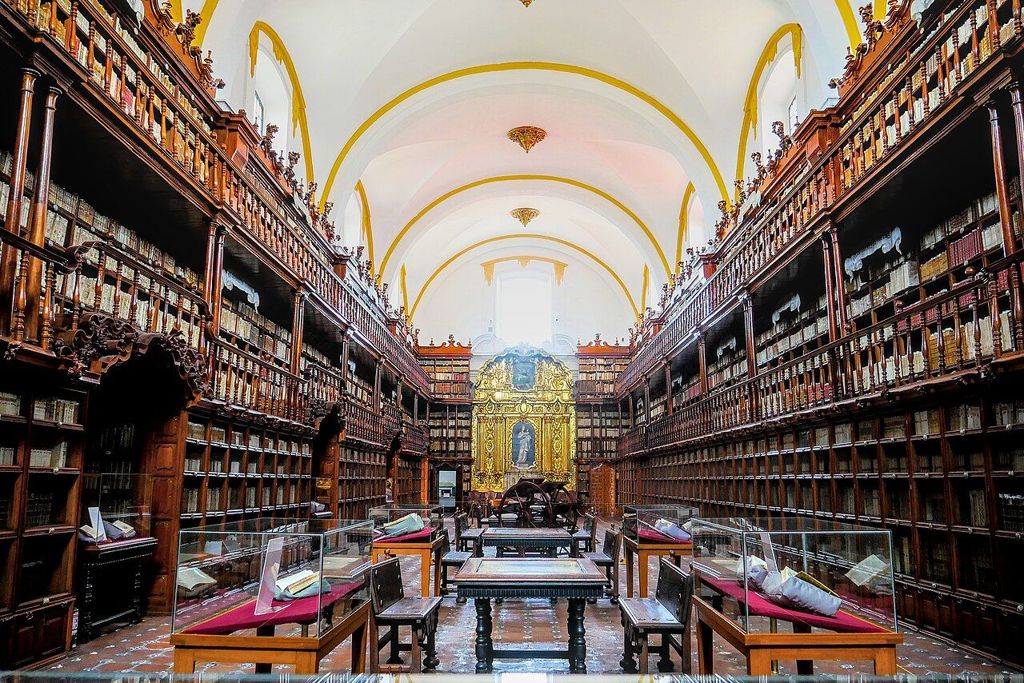
Up a stone staircase beside Puebla Cathedral, a single long hall of carved shelves holds one of the oldest library collections in the Americas. A short visit is enough, and worth the climb.
- Best months: Any month, mornings are quietest
- Getting there: Beside the cathedral, south of the zócalo
- Bring: Quiet voice, small bag, patience at the door
- Altitude: About 2,100 m: cool inside the thick walls, warm sun outside, afternoon rain in summer.
Many cities claim an old library. Puebla's claim is unusual: the Biblioteca Palafoxiana is widely regarded as the first public library in the Americas, and its hall has survived in much the shape it took in the eighteenth century. It is not large. You can see the whole room in a few minutes from the doorway. But the long gallery of wooden shelves, three tiers high under a white vaulted ceiling, is one of the most striking interiors in Mexico.
A bishop's gift
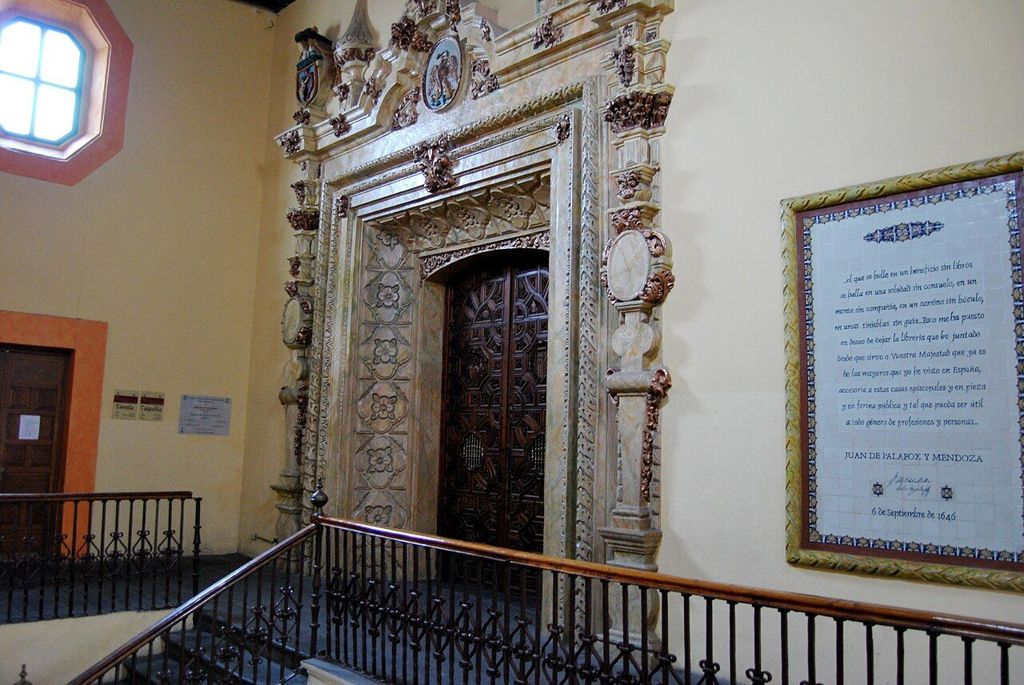
In 1646 Bishop Juan de Palafox y Mendoza gave his personal library, several thousand volumes, to the colleges he had founded in Puebla. His condition was that the books should be open to anyone who wanted to read and study, not only to the clergy and students of the college. That condition is the root of the library's claim to be the first public library on the continent.
Palafox was one of the most important figures in colonial Puebla. He pushed the completion of the cathedral on the zócalo, which was consecrated under him in 1649, and his name still marks streets, schools and institutions across the city. A tile panel on the stairway beside the library entrance reproduces part of his statement of donation, dated 1646.
The hall and its shelves
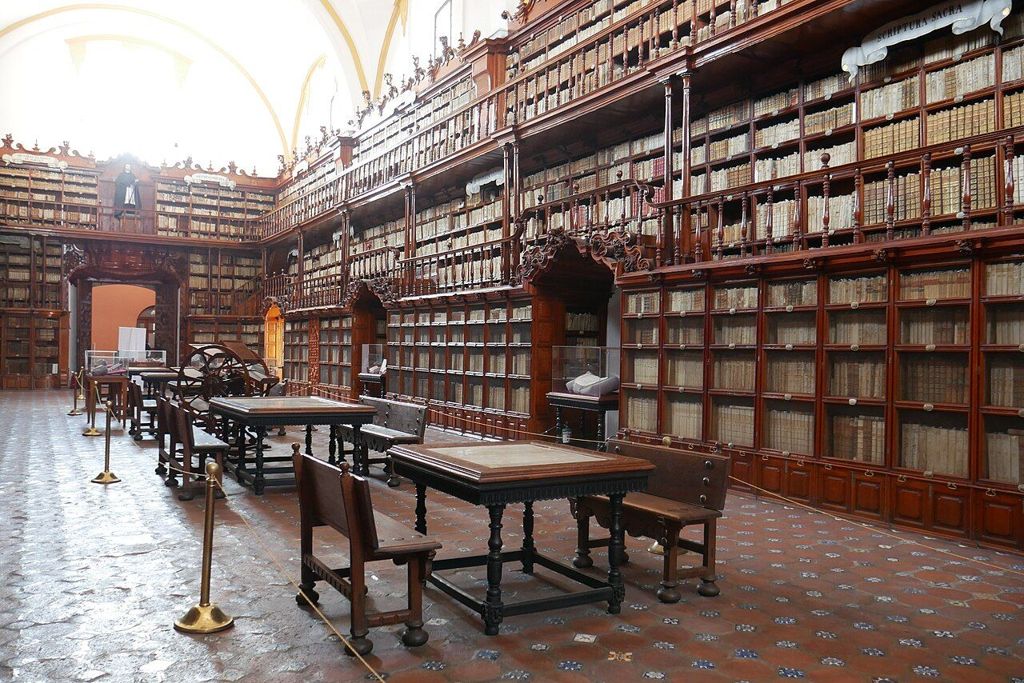
The room you see today dates mostly from the eighteenth century, when a later bishop, Francisco Fabián y Fuero, enlarged the collection and had the present hall built. It is a single long gallery with a barrel vault, its walls lined from floor to ceiling with shelving in dark carved wood. The shelves rise in three tiers, reached by narrow walkways with balustrades, and the books stand in rows of pale vellum and leather spines.
At the far end stands a gilded altarpiece with a painting of the Virgin, a reminder that this was a church foundation. Down the middle of the hall, old reading tables and a revolving book wheel stand on a tiled floor, and glass cases display open volumes. The effect, with the light falling from the high windows, is of a room that has been arranged for reading rather than for show.
What the collection holds
The library holds tens of thousands of volumes, most of them printed between the sixteenth and nineteenth centuries, along with manuscripts and a small number of incunabula, books printed in Europe before 1501. The subjects reflect the interests of a colonial college: theology and church law above all, but also philosophy, history, medicine, geography and the sciences of the time. Books came in many languages, from Latin and Spanish to Greek, French and Italian.
Also in Puebla: Atlixco and the view of Popocatépetl
In 2005 UNESCO added the library's collection to its Memory of the World register, which recognises documentary heritage of world importance. The books are handled only by specialists, and you will not be able to take one down from a shelf. What you see is the collection in its setting, which is the point of a visit.
Earthquakes and care
Puebla lies in an active seismic region, and the library has been damaged more than once. Earthquakes in 1999 and 2017 led to periods of closure and restoration work on the building and the shelving. The thick walls and the careful control of light, temperature and humidity inside are part of how the collection survives. If parts of the hall are closed, roped off or under repair when you arrive, that is why.
Planning a short visit
The library occupies the upper floor of the old college building on the south side of the cathedral, now a cultural centre. You enter from the courtyard and climb a stone staircase. Visitors usually view the hall from a set area near the entrance and along a roped route, which keeps numbers manageable and protects the books.
- Opening days and hours change, and the library has closed for repairs before. Check before you go.
- There is usually a modest entry fee, sometimes with free days; confirm the current arrangement on arrival.
- Large bags may not be allowed in. Bring a small one.
- Photography rules vary, and flash is commonly forbidden. Follow the staff's directions.
- Mornings on weekdays tend to be quieter than weekends.
Allow twenty minutes to half an hour for the hall itself, a little more if there is an exhibition downstairs in the cultural centre. Before you leave the doorway, take a last look down the length of the room: the way the shelves recede towards the gilded altar is the view most people remember, and it is easiest to take in once the first rush of detail has passed.
Around the library
Because it sits beside the cathedral, the library fits neatly into a morning in the old centre. Visit the cathedral first, then the library, then walk a few blocks to see the tiled house fronts that make Puebla's streets so distinctive; the guide to Talavera façades suggests a route. The tiled stair and floor at the library are a small preview.
The walk from the library out to the zócalo takes a minute. If you have a full day, a short ride west brings you to Cholula and its pyramid, and the high ground south-west of the city, towards Atlixco, gives views of the volcano on clear mornings.
The library also rewards a second look later in a trip. Once you have seen the tiled domes, the gilded chapels and the grey stone of the cathedral, the hall reads differently: a room built by the same church and the same city, but given over to books rather than worship.